
Products · SAW Solar Home
Solar panels for your home
Lower your power bill with the sun. We design, install and handle the paperwork for the whole system, from the site visit to the grid connection.
Estimate my savings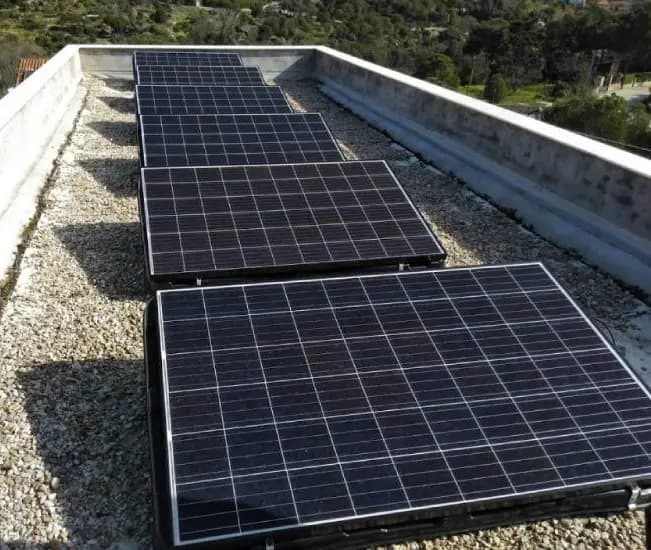
Three ways to go solar
We choose with you the one that fits your home and what you're after.
SAW HOME GRID
Savings
Connected to the grid
During the day your home uses the power from its panels. What's left over goes to the grid and is credited on your bill (net billing).
The most affordable option. By safety rule, it switches off during a power cut.
SAW HOME HYBRID
Backup
With a battery
It also stores power in a battery to use at night and to keep the lights on during a power cut.
You choose what stays on during a cut: fridge, lights, internet, pumps.
SAW HOME OFF-GRID
Off-grid
No grid connection
For plots and homes without a grid connection: the panels and battery power the home on their own.
Sized for the months with the least sun, with a margin.
An example
A home with 5.5 kWp on the roof
This is what a typical system looks like for a grid-connected home. We size yours from your consumption and your roof.
- of solar panels
- 5.5kWpof solar panels
- panels
- 10 × 550Wpanels
- single-phase inverter
- 5kWsingle-phase inverter
- a year, about 625 kWh a month
- ≈ 7,500kWha year, about 625 kWh a month
- Yearly production
- Between 6,300 and 8,600 kWh, depending on the sun where you live
- Roof space
- About 26 m² of panels, plus walkways and setbacks
- Connection
- 220 V single-phase, with a bidirectional meter
- With a battery (backup option)
- 10 kWh store about 7.2 usable kWh: around 7 hours at 1 kW for the essentials, without sun
The regulations we follow
Every installation is designed, built and declared under the SEC's rules.
- Law 21,118
- Distributed generation: feeding surplus into the grid (net billing).
- RGR No. 02/2024 (SEC)
- Design and installation of grid-connected photovoltaic systems.
- RGR No. 01/2024 (SEC)
- Notification and energization procedure.
- RGR No. 06/2024 (SEC)
- Battery storage and its safety.
- RIC No. 9.1/2021
- Design of off-grid photovoltaic systems.
Since 2026, inverters in new TE4 declarations must have built-in arc-fault protection (AFCI).
Not a final design or a guaranteed output: the final calculation accounts for shading, orientation, tilt and your hour-by-hour consumption.
What's included
- Site visit: roof, electrical panel and shading
- Design tailored to your consumption
- Panels, inverter and mounting structure
- Installation on the roof or on the ground
- Declaration of the installation to the SEC (TE4)
- Grid connection paperwork with the utility and a two-way meter
- Generation monitoring from your phone
- Handover with an explanation of how your system works
How it works
- 1
Estimate your savings or write to usYou
Have your power bill at hand: the estimator gives you a first figure in a minute.
- 2
Site visitSUN & WIND
We check the roof or the land, the electrical panel and the shading.
- 3
ProposalSUN & WIND
System size, equipment, price including VAT and the estimated savings.
- 4
InstallationSUN & WIND
In a few days, by authorized staff, with your home running as usual.
- 5
Declaration to the SECSUN & WIND
We declare the installation (TE4), as the rules require.
- 6
Connection and meterUtility
The utility checks it, installs the two-way meter and the credit on your bill begins.
Clear price, guarantee and financing
Price including VAT
The proposal shows the final price, no fine print, and what each item includes.
Guarantees
Besides the 6-month legal guarantee, panels and inverter carry a manufacturer's warranty; each brand's terms are in the proposal.
Financing
You can pay in cash or with a loan from your bank; some, like BancoEstado, offer energy-efficiency loans. We give you the details the bank asks for. SUN & WIND doesn't grant or guarantee loans.
Where we install
In the Atacama, Coquimbo and Valparaíso regions. In other regions, we assess each case.
Do you have, or plan to get, an electric car?
Two ways to charge it with the sun
Home solar + a connected charger
We size the panels including the car's consumption and install a charger connected to your home. The panels power both the home and the car.
Quote home + carStandalone solar charger
A separate unit, with its own panels and battery, that only charges the car. It doesn't connect to your home or the grid.
See the charger
FAQ
Frequently asked questions
What happens during a power cut?
A grid-tied system without a battery switches off during the cut: it's a safety rule that protects the people repairing the grid. If you want to keep the lights on, the battery option powers whatever you choose.
Does it work on cloudy days and in winter?
Yes, but it generates less. That's why the system is sized on a full year's production in your area, not on a summer day. In northern Chile the sun performs very well most of the year.
How long does it take to pay for itself?
It depends on your consumption, your tariff and the system size. The solar estimator gives you a range of savings and payback years from your bill.
Open the solar estimatorWhat happens to the power I send to the grid?
Under net billing, the utility values what you send and credits it on your bill. If you send more than you use in a month, the balance is credited on the following bills.
Is my roof suitable?
We install on metal sheet, concrete and tiled roofs. On the visit we check that the structure and anchors can take the weight and the wind, the seals so there are no leaks, corrosion near the sea, shading and orientation, and safe access for maintenance. If the roof isn't a good fit, the panels can go on the ground.
What maintenance does it need?
Very little: clean the panels a few times a year (more often with dust or near the sea) and check in the app that it's generating. The inverter alerts you if something fails.
What paperwork is involved?
The declaration of the installation to the SEC and the connection with the utility, which installs the two-way meter. We handle both and keep you posted at each step.
Can I charge my electric car with the panels?
Yes: with a charger connected to your home, sizing the panels with the car's consumption. If you'd rather not touch your home's wiring, there's the standalone solar charger.
See the solar chargerHow much could you save?
Have your power bill at hand. In a minute we'll give you a first figure, free and without signing up.
A housing complex or a real-estate development? See the solution for projects